
RAE Institute workshop and policy training session

Our Framework

Reparative Systems Practice

A macro social work and public health framework designed to repair systems that have caused harm — moving institutions from acknowledgment to structural repair.

Ethical Foundation

Five Principles of Reparative Justice

The Ethical Foundation of Our Work

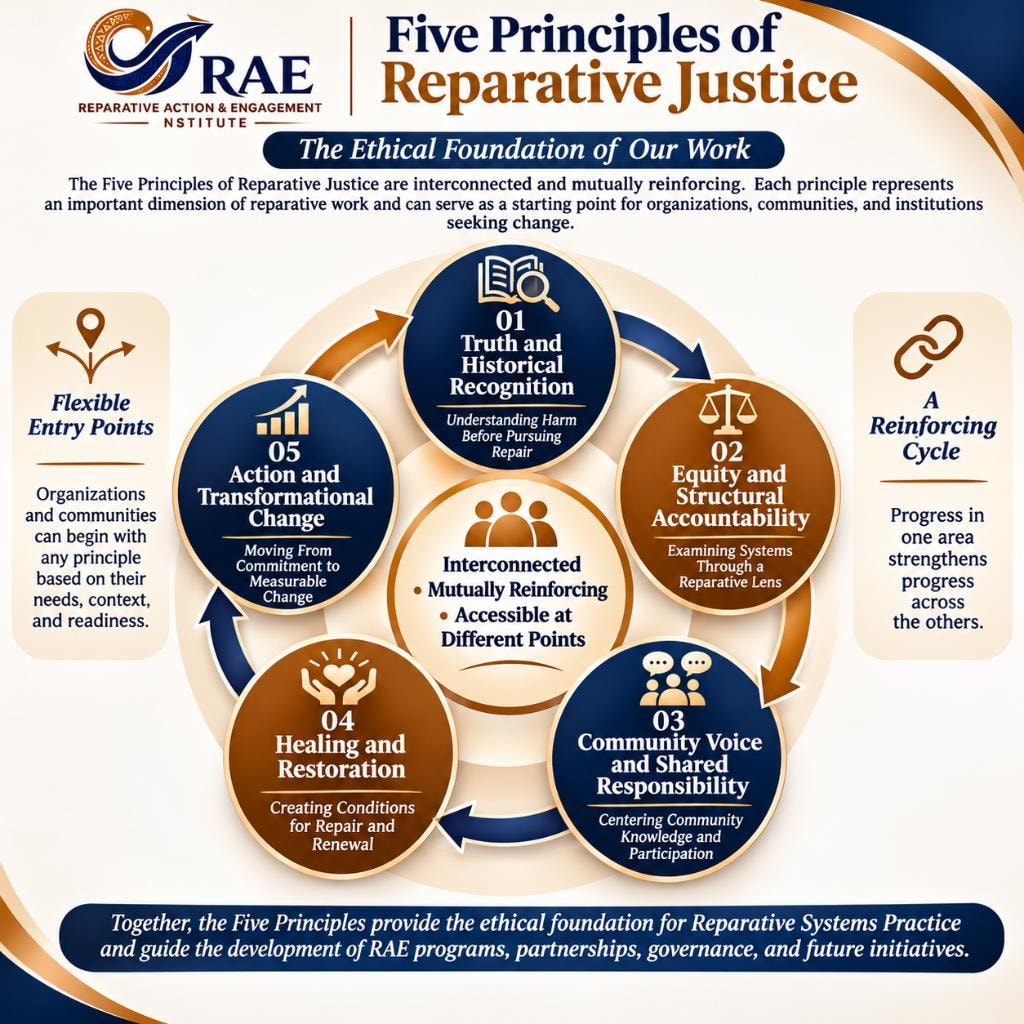
The Five Principles of Reparative Justice are interconnected and mutually reinforcing. Each principle represents an important dimension of reparative work and can serve as a starting point for organizations, communities, and institutions seeking change.

Some organizations begin by examining historical harm. Others focus on accountability, community engagement, healing, or action. Wherever the work begins, progress in one area strengthens progress across the others.

Together, the Five Principles provide the ethical foundation for Reparative Systems Practice and guide the development of RAE programs, partnerships, governance, and future initiatives.

Reparative Systems Practice framework infographic showing five interconnected principles: Truth and Historical Recognition, Community Voice and Shared Responsibility, Action and Transformational Change, Healing and Restoration, and Equity and Structural Accountability
01

Truth and Historical Recognition

Understanding Harm Before Pursuing Repair

Meaningful change begins with truth. We believe that institutions, systems, and communities must honestly examine the historical and contemporary conditions that have contributed to inequity, exclusion, and trauma. By acknowledging how harm is created and sustained, we establish the foundation necessary for accountability, healing, and transformation.

02

Equity and Structural Accountability

Examining Systems Through a Reparative Lens

We recognize that inequities are often rooted in the design, implementation, and administration of systems. This principle calls on institutions to examine how policies, practices, and decision-making processes affect communities and to take responsibility for addressing structural barriers that contribute to unequal outcomes.

03

Community Voice and Shared Responsibility

Centering Community Knowledge and Participation

Communities possess valuable knowledge, lived experience, and expertise. We believe that those most affected by systems should have meaningful opportunities to inform decisions, shape priorities, and participate in creating solutions that affect their lives and well-being.

04

Healing and Restoration

Creating Conditions for Repair and Renewal

Healing is essential to reparative work. This principle recognizes the effects of historical harm, systemic inequity, and transgenerational trauma while promoting resilience, dignity, belonging, restoration, and community well-being.

05

Action and Transformational Change

Moving From Commitment to Measurable Change

Awareness alone is not enough. Transformational change requires intentional action, measurable outcomes, and sustained accountability. We are committed to advancing approaches that translate understanding into meaningful and lasting improvements for communities and institutions.

From Principles to Practice

Principles Guide Belief. Pillars Guide Action.

The Five Principles of Reparative Justice provide the ethical foundation for the work of the RAE Institute. The Five Pillars of Reparative Systems Practice translate those commitments into action. Together, they create a continuum of reparative work.

Truth and Historical RecognitionRecognition
Equity and Structural AccountabilityAnalysis
Community Voice and Shared ResponsibilityEngagement
Healing and RestorationReparation
Action and Transformational ChangeEvaluation

While the Principles describe what we believe, the Pillars describe how those beliefs are applied within organizations, institutions, communities, and systems.

Five Pillars of Reparative Systems Practice

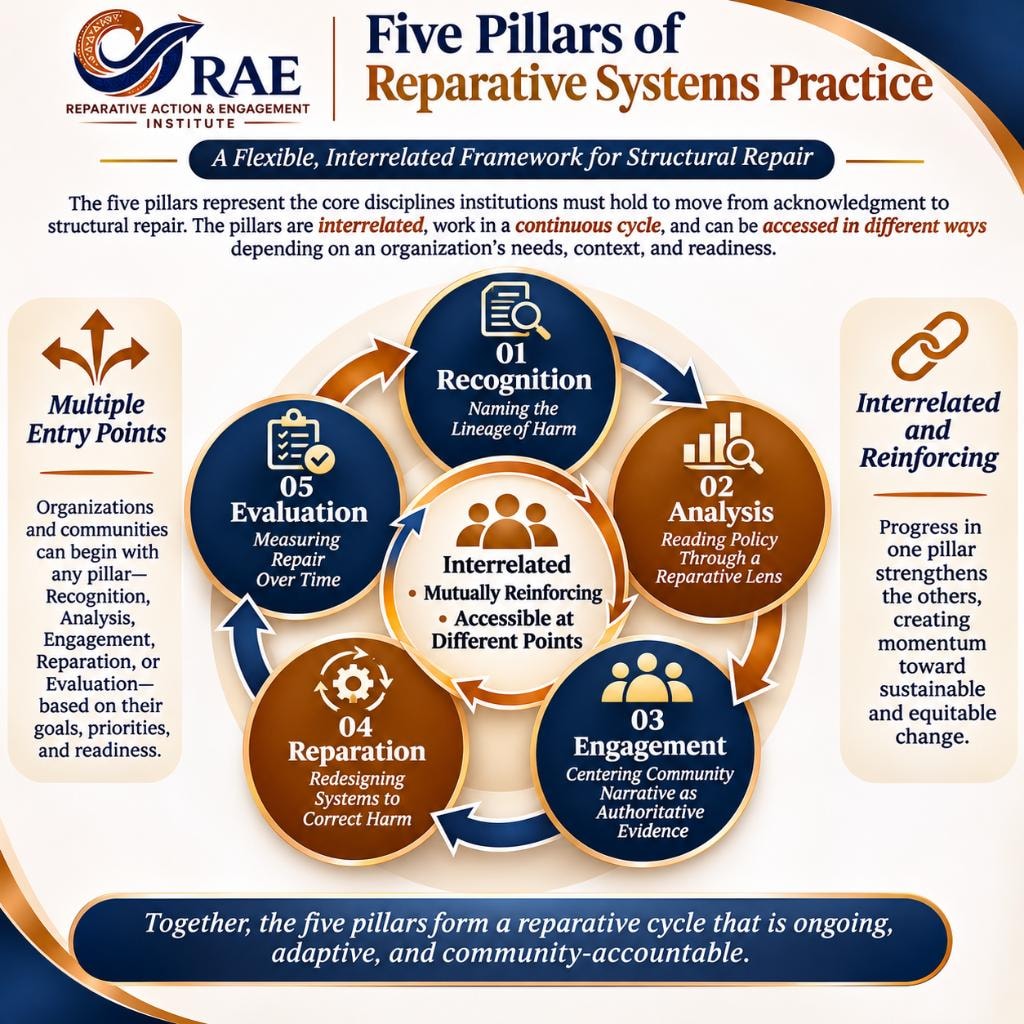
The five pillars represent the core disciplines institutions must hold to move from acknowledgment to structural repair. These pillars operate simultaneously and form the foundation of reparative governance, policy practice, and community-centered systems change.

Five Pillars of Reparative Systems Practice infographic: Recognition, Analysis, Engagement, Reparation, and Evaluation forming a continuous cycle of learning, action, accountability, and improvement
01

Recognition

Naming the Lineage of Harm

Recognition is the discipline of institutional truth-telling. It requires systems to confront the historical, structural, and administrative patterns that have produced inequity. This includes acknowledging racialized assumptions in policy, administrative burdens that disproportionately harm marginalized groups, and the trauma produced through routine institutional functioning. Recognition is not apology; it is structural accounting and the foundation of all reparative work.

02

Analysis

Reading Policy Through a Reparative Lens

Analysis examines how systems produce harm through design, discretion, and implementation. It asks who benefits, who is burdened, what trauma is reproduced, and what assumptions shape policy. This pillar teaches institutions to see policy as a mechanism of power rather than neutral text. It aligns with macro social work's tradition of structural analysis and public health's focus on systemic determinants.

03

Engagement

Centering Community Narrative as Authoritative Evidence

Engagement requires institutions to treat community narratives as valid data, not anecdotal input. It is not outreach or consultation; it is narrative sovereignty, trauma-informed dialogue, shared decision-making, and community-defined priorities. Engagement redistributes epistemic authority by shifting who gets to define harm and shape policy.

04

Reparation

Redesigning Systems to Correct Harm

Reparation is the structural redesign of policies, practices, and administrative systems. It moves institutions from acknowledgment to action. Reparation requires naming harm, redesigning eligibility criteria, restructuring administrative processes, redistributing discretion and power, and embedding community voice into governance. Reparation is measurable, enforceable, and structural.

05

Evaluation

Measuring Repair Over Time

Evaluation ensures reparative change is real, sustained, and accountable. It requires tracking long-term outcomes, monitoring administrative burden, assessing racialized patterns in access and denial, revising policies based on community feedback, and maintaining transparency in reporting. Evaluation is not compliance; it is accountability and prevents regression.

How the Pillars Work Together

The pillars are interdependent: Recognition without Analysis is incomplete; Analysis without Engagement is extractive; Engagement without Reparation is performative; Reparation without Evaluation is unsustainable; and Evaluation without Recognition is meaningless.

Together, they form a reparative cycle that is ongoing, adaptive, and community-accountable.

How We Work

Organizational Assessment

Policy Analysis

Community Engagement Design

Training and Capacity Building

Ready to Begin Reparative Work?

The RAE Institute partners with institutions, agencies, and communities committed to structural repair. Our work begins with honest assessment and ends with measurable change.

Get Involved

Advancing justice through research, policy advocacy, and community-centered action. We believe reparative justice is not a destination — it is a practice.

Stay Informed

Receive updates on our research, events, and advocacy work.

© 2026 Reparative Action and Engagement Institute. All rights reserved.